2026-06-07
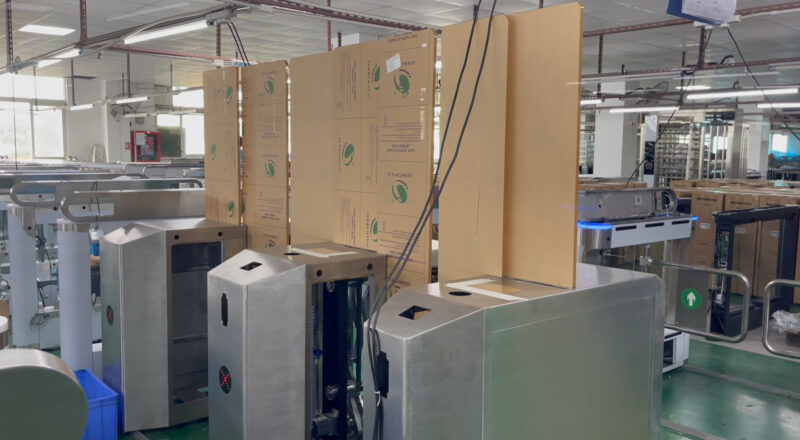
The mechanism is the mechanical heart of an automatic pedestrian gate. It converts the controller's command into barrier movement and determines how quickly, smoothly and accurately the gate opens and closes.
For a buyer, two turnstiles may look almost identical from the outside while performing very differently after installation. One of the biggest reasons is the internal mechanism.
Inside a speed gate or swing barrier, the mechanism connects the motor, transmission structure, barrier shaft and control system.
Its job is not simply to move the glass or swing arm. It must accelerate the barrier, control its position, slow it down before the end point, respond to an obstacle and repeat this movement thousands of times under daily traffic.
A well-designed mechanism therefore affects passage speed, sound, vibration, safety and service life at the same time.
Automatic turnstiles commonly use brushless DC or servo drive technologies.
Brushless DC motors can provide smooth operation, low maintenance and good durability because there are no mechanical brushes to wear in the traditional way.
Servo systems are often selected when more precise closed-loop position and motion control is required.
However, motor type alone does not determine quality. Gear design, bearings, shaft support, structural rigidity, control software and installation accuracy all influence the final performance.
A premium gate should not simply open as fast as possible.
If the barrier accelerates too aggressively, movement can feel unstable and create unnecessary mechanical shock. If it closes too slowly, throughput can be reduced. The control system should therefore balance speed and smoothness according to the lane design and pedestrian behavior.
Controlled acceleration and deceleration can also reduce noise and mechanical stress over long-term operation.
In a multi-lane entrance, the left and right barriers should align consistently when closed and move in a coordinated way when opening.
Poor mechanism alignment may cause uneven gaps, visual inconsistency or contact with the cabinet. This is why mechanism mounting positions and cabinet manufacturing accuracy must work together.
Anti-Pinch Performance Requires Fast Response
Modern automatic turnstiles use sensors to determine whether a pedestrian or object remains inside the lane.
When the control system detects an obstacle, the mechanism must react quickly enough to stop or reverse movement according to the configured safety logic.
This means anti-pinch performance is not created by sensors alone. The motor control and mechanical response are also essential parts of the safety system.
Buyers often ask whether a servo motor is quieter than a brushless motor. In practice, gate noise depends on the complete structure.
The motor, gearbox, bearings, barrier shaft, cabinet stiffness and installation floor can all contribute to sound and vibration.
A well-engineered mechanism should minimize unnecessary impacts and maintain consistent movement over repeated operation.
Why Service Life Depends on More Than a Cycle Number
Manufacturers may describe mechanism life using operating-cycle targets, but real-world durability also depends on traffic conditions, installation quality and maintenance.
A mechanism working in a quiet office lobby has a different duty profile from one installed at a transportation hub or factory entrance.
For this reason, buyers should evaluate not only the stated life target but also the design architecture, service access, spare-parts availability and technical support.
Maintenance Accessibility Reduces Downtime
Even a reliable mechanism may eventually need inspection or component replacement.
A well-designed turnstile should allow technicians to access the motor, controller, transmission parts and key fasteners without dismantling the entire cabinet.
Clear wiring, modular parts and logical internal layout can significantly reduce maintenance time.
When comparing turnstile mechanisms, project teams can ask:
Is the drive brushless DC or servo? How is barrier position controlled? How does the gate respond to obstacles? How are acceleration and deceleration managed? How is the mechanism mounted and reinforced? Can key parts be serviced or replaced easily? What testing is performed before shipment? Are spare parts and technical documentation available?
These questions provide a more complete view of product reliability than appearance or motor type alone.
VELAXIZ Focus on Mechanism Engineering
VELAXIZ develops pedestrian gates with the mechanism, cabinet, sensor system and controller designed as an integrated platform. Different gate models can be configured according to project requirements for traffic volume, lane width, architectural design and access control integration.
For commercial buildings, transportation projects, residential communities and industrial facilities, mechanism reliability directly affects the daily experience of every person using the entrance.
A good turnstile mechanism should be almost invisible to the user: the gate opens when expected, moves smoothly, responds safely and continues doing so day after day.
What is a turnstile mechanism? It is the internal mechanical and drive assembly that moves and controls the barrier arm or glass panel of an automatic pedestrian gate.
Is a servo mechanism always better than a brushless mechanism? No. Both can be suitable. The correct choice depends on the complete gate design, required motion control, operating frequency and project budget.
What causes a turnstile to become noisy? Possible causes include wear, loose parts, poor alignment, gearbox issues, cabinet vibration or incorrect installation.
Why is mechanism maintenance important? Regular inspection can help identify loose fasteners, wear or abnormal movement before they create downtime.
About VELAXIZ VELAXIZ specializes in pedestrian access control products including speed gates, swing barriers, flap barriers, tripod turnstiles, full-height turnstiles and customized entrance solutions.