2026-09-14
Outdoor turnstile projects require more planning than indoor installations. Rain, humidity, direct sunlight, dust, temperature changes and drainage conditions can all influence long-term equipment reliability. For industrial parks, construction sites, stadiums, residential communities and perimeter-security applications, correct installation is just as important as selecting the right turnstile.
Not every indoor turnstile is automatically suitable for outdoor installation. Before ordering, confirm whether the selected model is designed for the expected environment. Consider rain exposure, humidity, dust, temperature and corrosion conditions.
Outdoor foundations must support the turnstile and withstand long-term movement and vibration. Full-height turnstiles, in particular, require accurate positioning and strong structural fixing. The foundation should be completed and cured before installation.
Water accumulation around the turnstile can create long-term problems. The installation area should allow rainwater to drain away rather than collect around the cabinet base. Drainage planning is especially important for exposed outdoor entrances.
Power and communication cables should be routed through protected conduit. Cable entry points should prevent water from travelling along cables into the cabinet. Whenever possible, wiring should enter through protected bottom or internal channels.
Even outdoor-rated equipment can benefit from additional shelter. A canopy can reduce direct rain, snow and solar exposure and may significantly improve equipment operating conditions. However, the canopy should not interfere with pedestrian flow or emergency evacuation.
Coastal environments, industrial areas and humid regions can increase corrosion risk. Material and surface-treatment selection should therefore match the installation environment. Stainless steel and suitable protective finishes are commonly considered for demanding outdoor conditions.
Outdoor electrical installations require proper grounding and protection. Depending on the site, additional surge and lightning protection may be appropriate. Power quality should also be evaluated where the turnstile is installed far from the main building.
Swing gates and large barrier panels can experience wind loading. The entrance design should consider local environmental conditions, particularly where large glass barriers are installed in highly exposed areas.
Do not install the gate so close to walls, fences or structures that maintenance panels cannot be opened. Technicians need sufficient space to access mechanisms, controllers and wiring.
Outdoor equipment should be inspected regularly. Important areas include: Cabinet seals Drainage Fasteners Mechanisms Barrier alignment Wiring Sensors Corrosion Surface condition Preventive inspection can identify minor issues before they become larger failures.
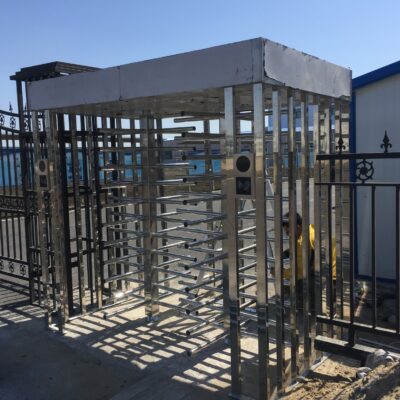
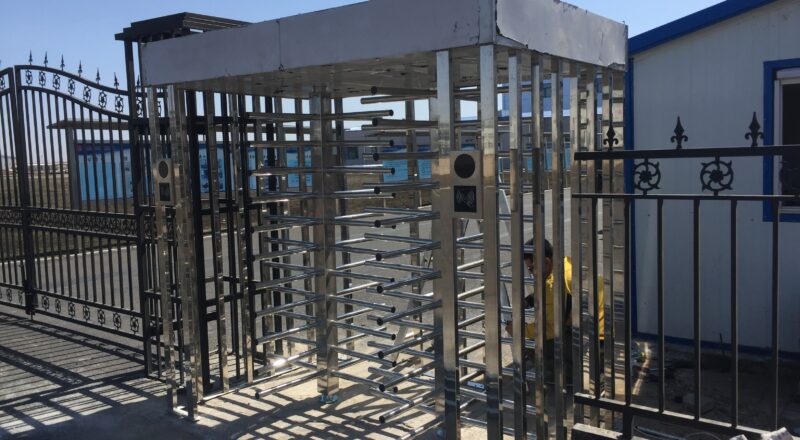
Full-height turnstiles are commonly used for outdoor perimeter security because they provide stronger physical control. When installing these products, special attention should be paid to base fixing, frame alignment, rotating mechanism clearance and adjacent fencing. A poorly aligned full-height turnstile can create unnecessary resistance and accelerate wear.
Can any turnstile be installed outdoors? No. The product and installation method should be suitable for outdoor environmental conditions. Does an outdoor turnstile need a canopy? Not always, but a canopy can reduce environmental exposure and improve operating conditions. Why is drainage important? Standing water can increase corrosion risk and potentially affect electrical components. Are full-height turnstiles suitable outdoors? They are commonly used for outdoor perimeter entrances when correctly specified and installed. Recommended Internal Links: Full Height Turnstiles / Tripod Turnstiles / Outdoor Solutions / Installation Support